Things I've built
I lead presales teams for a living. I also build the software myself — architecture, code, and ship. Everything below is real, working software I designed and built, not a slide about something a vendor demoed to me.
The site you're on is one of them: cvAI, an AI assistant grounded in my own career, built on a Cloudflare Worker with the model call and context kept server-side. Here's how it works.
Projects
Run your business from a prompt — with a governor in the middle. A natural-language front end that provisions and revokes real access across an identity provider, an ITSM platform, and a data warehouse. The core is a decision engine that evaluates every requested entitlement against cost and sensitivity rules and returns auto-approve, flag, or deny — so the agent only executes what policy already allows, and a human sees the rest. Every action lands in a hash-chained audit log that can be verified end to end. It also catches agent overreach: when the agent asks for more than the task needs, the request is held for approval and the payload withheld.
A members-only school directory for the Tewksbury Township (NJ) PTA. I designed it around two kinds of users. Parents mostly look someone up on a phone, so the directory is search and filter by child, grade or teacher, with one-tap call, email and "add to contacts." The admins are volunteers and the board changes every year, so the admin side opens on one question: what do you need to do? Each job is a short, guided path, not a page of settings. Starting a new school year is four steps.
Privacy is part of the design: each family chooses Yes or No for every detail, only paid members can sign in, and the security rules on the database enforce it rather than the page. It ships with picture guides, a one-step undo for admin changes, and a handover document a new board can give to an AI assistant. It runs on Firebase's free plan with 129 automated tests, and has been in use since October 2026.
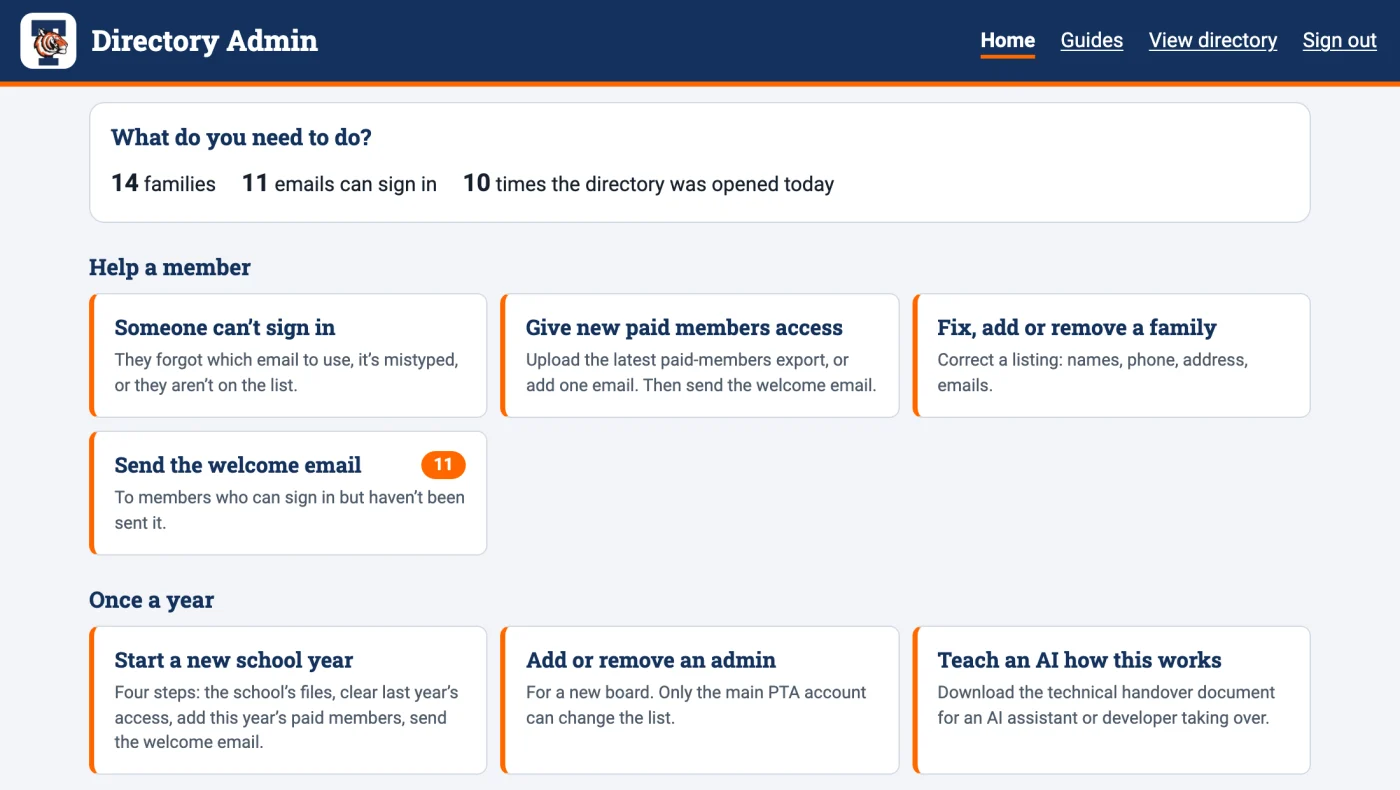
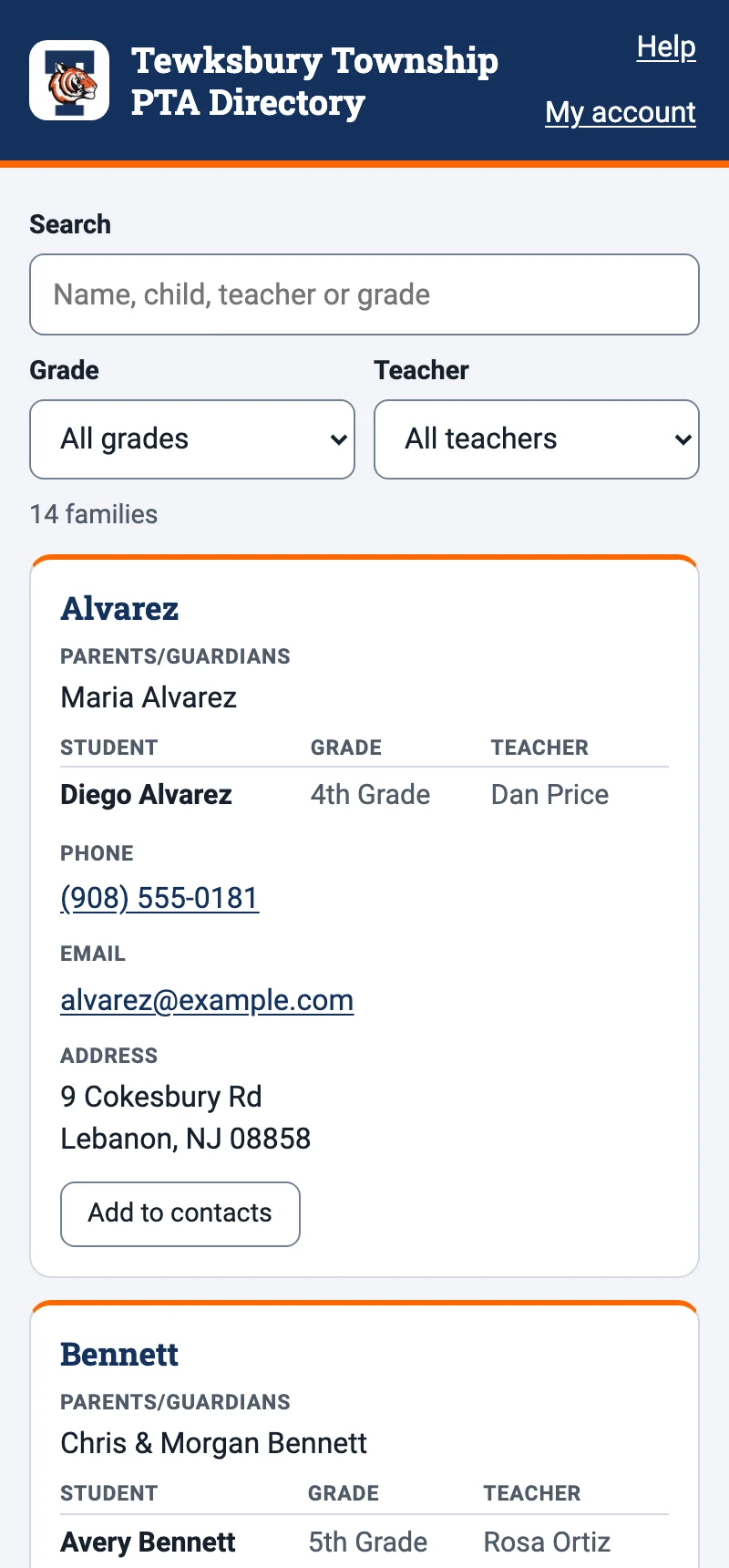
Screenshots use made-up families, not real member data.
Membership running on software instead of a spreadsheet. A member-management portal for the Central Jersey Corvette Club, which has 82 members and 100 Corvettes. It runs the roster, member and car records, dues and reminders, reports, member email, and an audit trail of admin actions. Its users are volunteer officers, not IT people, so the design keeps one meaning per color and label everywhere. A dashboard answers the questions officers actually ask: who's paid, who's past due, and what's in the garage.
Running it in production shaped the features. Removing a member moves them to a Former Members archive they can be reinstated from, rather than deleting them. A roster re-import updates existing members instead of duplicating them. Treasurers get their own role. I ship it in versioned releases with an illustrated admin guide, error capture, and 224 automated checks run before every upload.
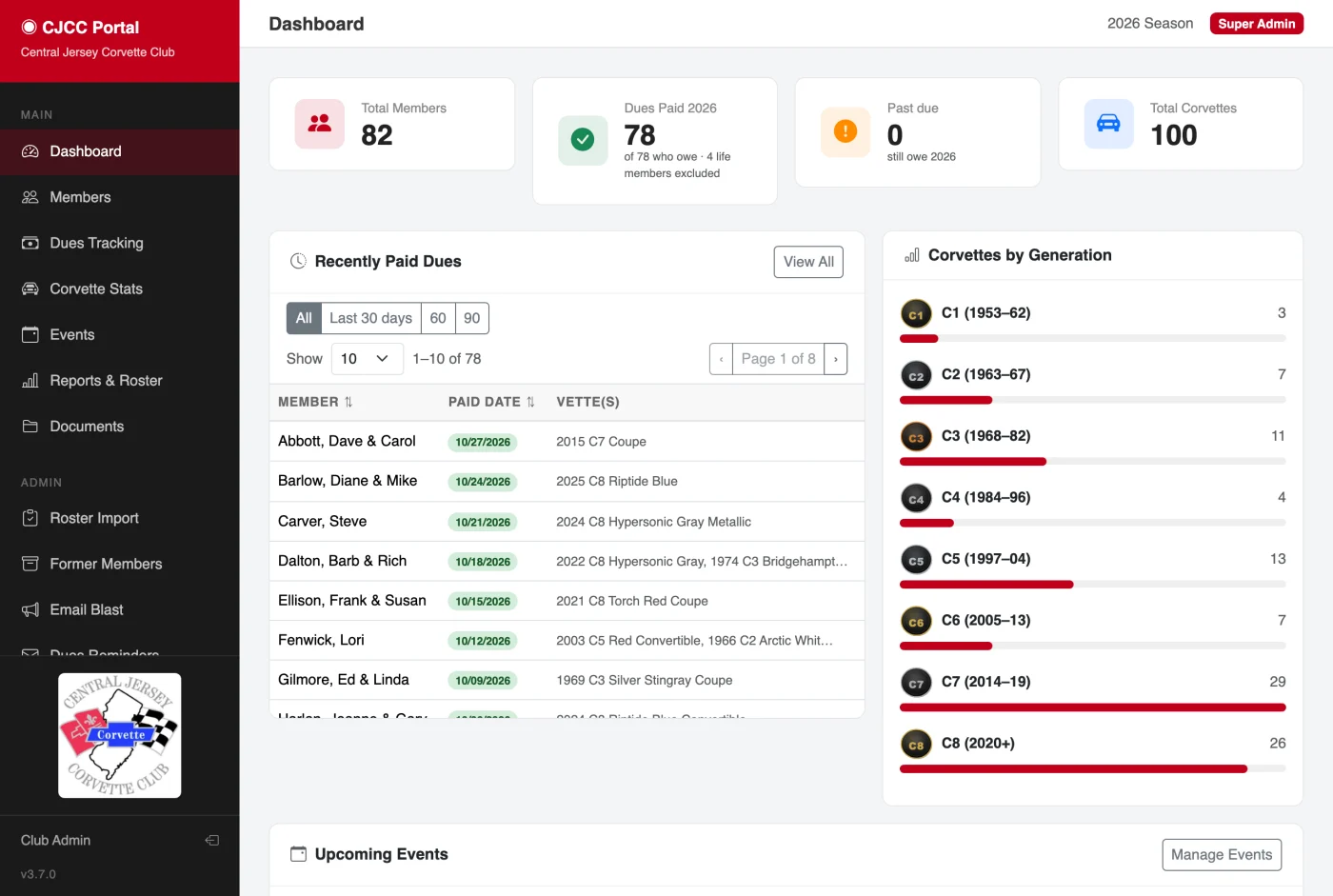
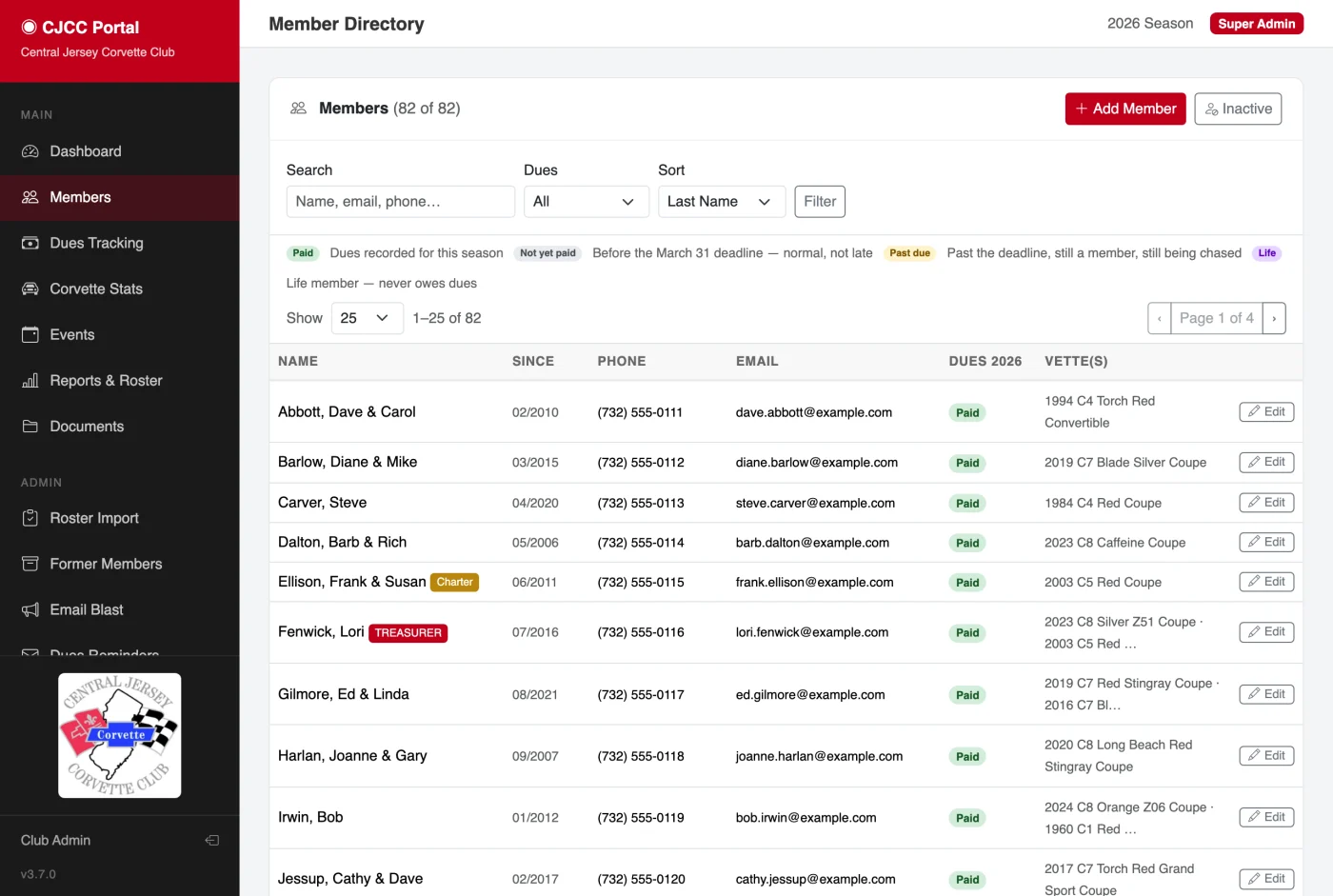
Screenshots are the live portal, with every member's name, phone, email and date replaced by made-up ones.
Kids earn screen time by finishing real-world missions. An iOS parental-controls app: a parent sets a daily limit, and most of it stays locked until the day's missions — homework, reading, chores — are done and approved. Limits are enforced by the OS itself through Apple's Screen Time frameworks, so they hold when the app is closed. Multi-child, multi-device, co-parent roles, all synced through the family's own iCloud with no server of mine in the middle.
The idea behind this site, turned into a product. A candidate gets an AI-interviewable résumé — a hiring manager can ask it questions at 11pm and get grounded answers instead of scanning a PDF. Built as a real service with its own interview pipeline for capturing a candidate's background, and a guardrail layer that keeps the assistant from inventing credentials.
Photos and music from your own machine, nothing uploaded. Point it at a folder of photos and some music tracks and it plays them full-screen. The files never leave the device — the browser reads them locally, so there's no upload, no account, and no storage bill. A small exercise in solving something completely client-side when the obvious answer would have been a server.
A friendly front end over two command-line tools. A
packaged macOS app that wraps yt-dlp and
ffmpeg behind a local web UI: paste a URL, get an audio or
video file. It fetches and updates its own dependencies on first launch
rather than bundling them, which keeps the download small and the tools
current. Built so people who would never open a terminal can use it.
A note on ES ONE. It's archived on purpose. It ran against live Okta, ServiceNow, and Databricks instances on free tiers, and I'm not maintaining those connections — so the interface and the governance flow are there to walk through, but the integrations are disconnected. Happy to give you the live version and a walkthrough of the code on a call.
Why this is here
I'm a presales leader, and the reason I build is that it makes me better at the job. It's why a demo I give holds up when an engineer starts asking real questions, why I can tell a customer what a platform genuinely can't do, and why my teams trust that when I coach them on a technical story, I've been through it myself.
If you want the detail behind any of these — the architecture decisions, what broke, what I'd do differently — ask the assistant on the home page, or just email me.